


2025: an Ibexa ecosystem moving toward greater convergence
On 5 November 2025, SQLI took part in the latest edition of the Ibexa Partner Event, held in Paris. The event brought together the community of partners and integrators around the three solutions of the QNTM group: Ibexa DXP, Quable PIM, and Raptor CDP. On this occasion, we wanted to look back on the past year to review the positioning, evolution, and outlook of Ibexa and its ecosystem.
Ibexa DXP 5.0
Ibexa continues to strengthen its positioning as a modular DXP, positioned halfway between specialised microservice architectures and monolithic suites. The platform aims to offer the best of both worlds: the flexibility and scalability of packaged business capabilities (PBCs) that can be activated with ease.
This positioning enables Ibexa to provide an open platform that can be adapted to organisations seeking to build a digital stack aligned with their specific business needs, while maintaining control over their technology investments.
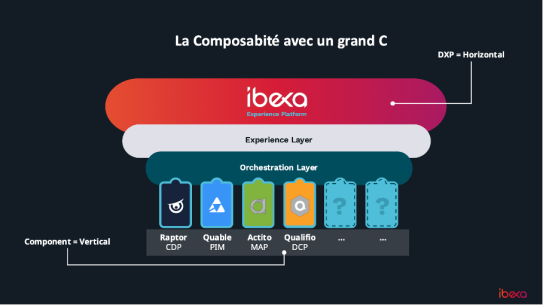
The latest major version of Ibexa DXP 5.0, released in July 2025 (v5.0.0), introduced several functional enhancements:
- Real-time / live collaboration: real-time content co-editing to streamline teamwork.
- E-commerce discounts: management of catalogue- or cart-level discounts based on simple rules (minimum amount or quantity) and applicable to targeted customers, groups, or products. Both percentage-based and fixed-amount reductions are supported.
- Product Picker: a back-office product selection tool designed to improve content/catalogue integration by offering a mosaic-style product view.
- Internal Notifications Revamp: notification management has been redesigned, making it easy to use the notification API to dispatch various types of short messages.
- AI Actions (with Ibexa Connect): the key new feature is AI Catalyst, an integration layer for AI services. It allows users to leverage multiple providers (OpenAI, Gemini, Meta, Claude) and chain AI actions such as text generation, rewriting, translation, or illustration search based on semantic analysis. Thanks to this feature, designing AI actions tailored to functional needs becomes straightforward through a user interface that supports fine-tuning of expected outcomes (max tokens, temperature, etc.).
On the technical side and in terms of the platform’s lifecycle, this release brought:
- A new release cadence: alternating between LTS versions (every 18 months) and intermediate releases. For reference, version 4.6 LTS will be maintained until February 2029, ensuring stability and visibility for ongoing projects.
- Symfony 7.3 as the new foundation: this upgrade of the technical core enables:
- Native support for PHP attributes (starting from PHP 8.3)
- Improved autowiring
- Readonly classes, enhanced enums, etc.
- A modernised HttpKernel & EventDispatcher
- Access to new Symfony components: symfony/html-sanitizer, symfony/type-info, symfony/asset-mapper, symfony/scheduler, symfony/emoji
- PHP Rector support: to simplify upgrades, via https://github.com/ibexa/rector
- Native OpenAPI support: for APIs provided by Ibexa
Quable PIM at the centre of product data management
The PIM is establishing itself as a key tool for centralising and enriching product information for brands and retailers, while simplifying the daily work of marketing and e-commerce teams.
The announcements made during the 2025 partner events reflect an even stronger shift toward automation and productivity.
The extended use of generative AI within the platform now makes it possible to mass-produce enriched product content — descriptions, SEO texts, or metadata — based on existing attributes. Bulk AI Enrichment provides significant time savings while ensuring editorial consistency across catalogues.
Quable’s interface has also benefited from improvements: unified navigation, a modernised user experience, enhanced asset management, and better overall readability of product sheets.
In addition, several client use cases were shared, illustrating the diversity of PIM usage contexts — from managing international product catalogues to data governance for D2C or B2B projects.
Raptor CDP: customer data powering personalisation
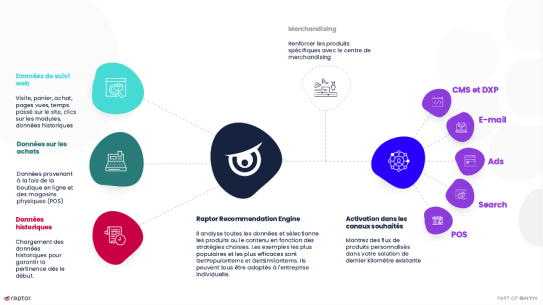
The Raptor CDP solution completes the chain by providing real-time customer knowledge. This Customer Data Platform, historically focused on collection and segmentation, is continuing its shift toward a more strategic role: personalised activation across all channels. The Raptor Recommendation Engine sits at the core of this evolution.
It aggregates data from browsing, purchases, and interactions, then selects the most relevant products or content based on context.
The recommendation strategies rely on several complementary approaches: global rules (popular or trending products), contextual rules (linked to a content type or category), and behavioural rules (focused on the user profile).
Together, these capabilities enable the orchestration of consistent experiences across websites, email campaigns, and mobile applications, while improving cross-selling and more.
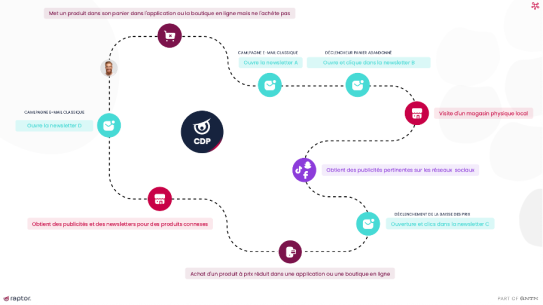
Raptor also unveiled its new approach to semantic search, which stands apart from traditional keyword-based search logic. It improves the relevance of results, handles synonyms and natural phrasing, supports multiple languages and dynamically adapts to user behaviour.
Conclusion
The year 2025 marks an important milestone in the convergence of the QNTM ecosystem platforms: delivering a complete value chain, enhanced by artificial intelligence, where content, product data, and customer data connect seamlessly and efficiently.
This momentum is accompanied by growing market interest in the ecosystem’s Euro-sovereign positioning, which meets expectations around security, compliance (GDPR), environmental impact, and technological independence for European organisations.
The integration of AI across all products is now emerging as a major driver of efficiency, productivity, and interoperability. The solutions benefit from tangible enhancements, whether in automation, content enrichment, or experience personalisation.
However, despite the availability of robust technical APIs, advanced integration between the products remains a significant undertaking. While the convergence between Raptor and Ibexa is now effective, the one between Quable and Ibexa is still in progress, illustrating the scale of the work required to ensure optimal interoperability. This context fuels anticipation around the announcements planned for the February 2026 Summit in Lisbon, which we hope will mark new steps forward in inter-product functional synergies.
Glossary
| Terme | Définition |
| PIM | Product Information Management – A product data management system used to centralise, enrich, and distribute product information across multiple channels. |
| DAM | Digital Asset Management – A system for managing digital content (images, videos, documents) used in marketing and digital materials. |
| CMS | Content Management System – A solution for creating, managing, and publishing web content. |
| DXP | Digital Experience Platform – Integrated platform for managing all of an organisation’s digital touchpoints. |
| PBC | Packaged Business Capabilities – Autonomous functional blocks representing a business capability, used modularly within a composable architecture. |
| CDP | Customer Data Platform – A platform that unifies customer data from different sources to personalise interactions. |
| LTS | Long Term Support – Software version benefiting from extended support over several years, useful for long-lifecycle projects. |
| Ibexa Connect | Low-code solution from Ibexa that connects third-party services and automates workflows through scenarios. |
| OpenAPI | Standardised specification for describing REST APIs in a format readable by both humans and machines. |
| Symfony | Open-source PHP framework used to build robust web applications, including the technical foundation of Ibexa DXP. |
| Workflow | Sequence of tasks and validations defining a publication or processing workflow within a CMS or PIM. |
| Segmentation | Segmentation — Dividing users or customers into homogeneous groups based on behavioural, demographic, or transactional criteria. |


