


“If They Can’t Find It, They Won’t Buy It”
Why Most Sites Still Get Search Wrong
Imagine visiting a webshop with a clear goal: find a specific product fast. According to Algolia, 43% of users head straight to the search bar. And those users? They’re not just browsing. They convert 2.4 times more often and spend 2.6 times more than users who don’t use search.
And yet, despite its potential, search is one of the most neglected features in E-commerce. While it drives revenue, it often performs like a leaky funnel. Irrelevant results. No autocomplete. Poor filters. And that leads to friction—and to lost sales.
This article helps business and merchandising teams recognize where their search funnel breaks, and what they can do to fix it.
We implemented a Search Solution for


Your Funnel is Leaking Revenue
Search is not a nice-to-have. It's the highest-intent channel in your webshop. When someone types into that bar, they’re not browsing. They know what they want.
The average E-commerce conversion rate in Europe is approximately 2.58%, but in the Netherlands it’s just 1.78%, according to Mailmodo. Every drop-off hurts.
But if that intent runs into friction—typos, irrelevant results, missing products—they bounce. In fact, Mailmodo also reports that 12% of users will leave your site entirely after a frustrating search experience, turning to competitors instead.
And despite the importance of search:
- 80% of e-commerce sites have autocomplete,
- but only 19% implement it effectively (Baymard Institute).
Let’s start at the surface: when a customer types into your search bar.
- Do they get relevant results?
- Does autocomplete help or distract?
- Is smart ranking turned on?
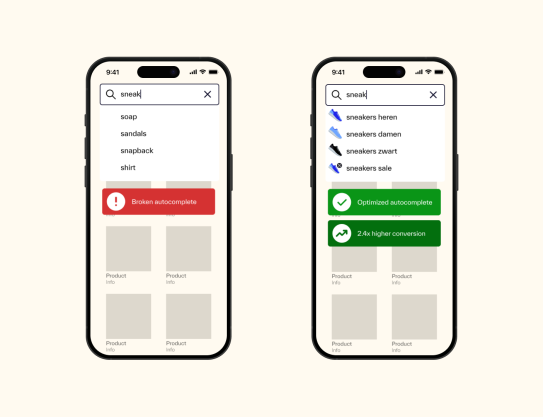
For one of our clients, a lack of smart ranking and indexing logic... meant high drop-off rates. After advising on their autocomplete and index model (via Algolia), their search experience became faster, smarter, and far more relevant—boosting engagement and reducing exits.
And they’re not alone.
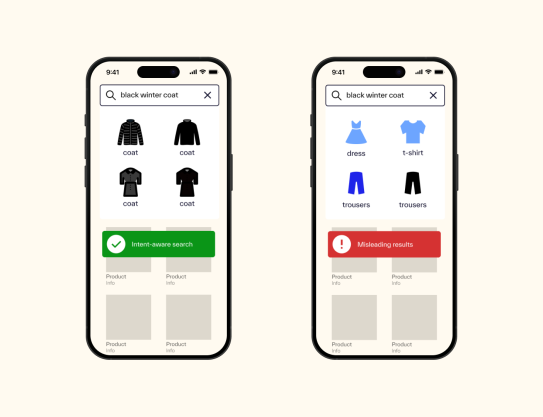
Search that doesn’t learn from user behavior becomes a guessing game.
Merchandising Without the Developer Bottleneck
In many organizations, merchandising teams rely on developers to:
- Promote seasonal items
- Reorder results
- Pin priority products
And while the campaign needs are fast-moving, the technical backlog usually isn’t.
We believe merchandising teams should be able to manage their own promotions without touching code.
"Pinning a product or running a promo shouldn’t take weeks."
Business teams need tools that let them launch campaigns in minutes, not sprints.
You Can't Fix What You Can't See
Even if your search looks good from the outside, the real question is:
- Are you tracking why it works or fails?
- Do you know what was searched, clicked, skipped, or added to cart?
In our work with our customer, we uncovered these blind spots during an audit of their product search and created a proof of concept to resolve them. The result? Visibility into the full search journey—from query to purchase.
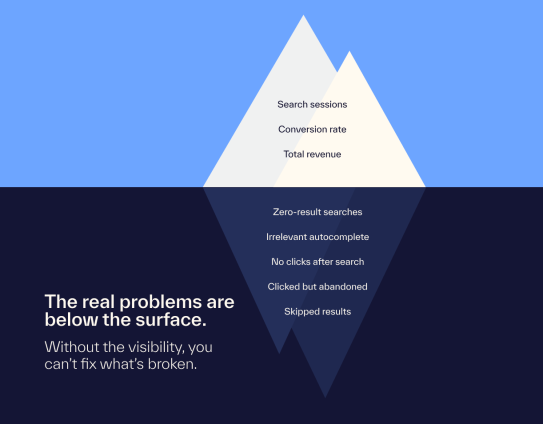
Too often, companies only track sessions or conversion rate. But what about the users who searched and didn’t click? Or those who clicked but didn’t add to cart?
If you can’t see drop-offs, you can’t fix them.
The solution isn’t one thing. It’s three:
- Search that adapts to behavior (and doesn’t frustrate)
- Merch tools that give control (without needing developers)
- Analytics that track the full funnel (not just the outcome)
“Search isn’t just a feature. It’s your revenue engine.”
