


“From Fast to Scalable: Search Built for Growth”
In 2024, cross-border e-commerce in Europe hit €275.6 billion—a 16% jump compared to the year before. That growth isn’t slowing down. It’s scaling. And if your search infrastructure can’t keep up, it’s not just a missed opportunity—it’s a blocker.
Across Europe, 28% of total e-commerce transactions are now cross-border (Avalara). At that scale, it’s no longer enough for your search to be accurate. It needs to be fast. Multilingual. Automated. And reliable across hundreds of thousands of products.
“Scaling search isn’t a luxury. It’s an enabler of global growth.”
This blog explores four recurring challenges in enterprise-grade search: synonym recognition, low-latency performance, real-time indexing, and multilingual scalability—with short reflections on what’s holding most companies back.
We implemented a Search Solution for


When "Jacket" Doesn't Match "Coat"
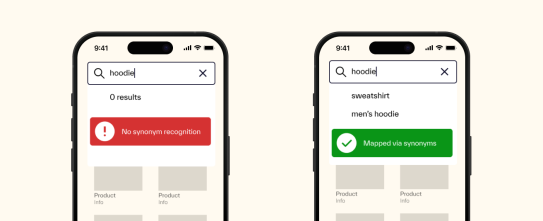
Search is often seen as a functional feature. Type a word, get a result. But the moment a shopper searches for “coat” and sees nothing because your catalog only lists “jacket,” that feature becomes a flaw. They don’t rephrase—they leave.
Synonym mismatches are a quiet conversion killer. And they happen more than we think. According to research, around 70% of desktop e-commerce platforms still fail on basic synonym recognition (LLCBuddy).
The hard truth? Manual synonym mapping might work for a dozen terms, but not for thousands of products in multiple languages. The moment you scale, it breaks. What’s needed is a system that learns from how people search.
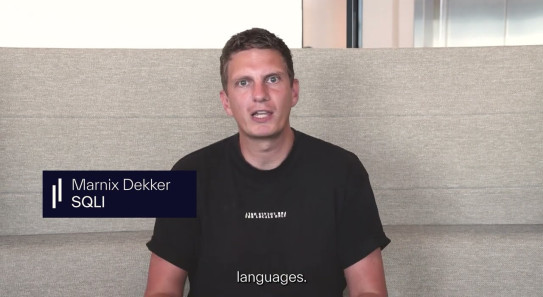
“We use automation. Manual input is impossible at scale—especially across languages.”
One of our clients tackled this head-on by implementing automated synonym recognition using real search data. That meant fewer no-result queries, more relevant hits, and ultimately—a smoother path to purchase.
Speed Isn’t Optional—It’s Expected
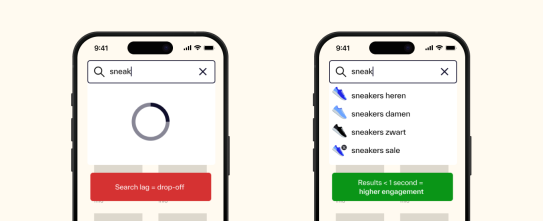
Let’s be honest: nobody waits for search results. If autocomplete doesn’t show up instantly, or results take longer than a second, users assume it’s broken. Not slow—broken.
Fast search has become the expectation. Autocomplete under 200ms. Search results under one second. That’s the bar.
“Search must be fast. Use caching, proper indexing, and distributed systems.”
Getting there isn’t just about technical tuning—it’s about foundational design. Distributed infrastructure, load balancing, smart caching. Without those, every product query becomes a bottleneck.
One of our projects involved optimizing the search query speed and therefore also the product page load time. The result? Users stayed longer. They clicked more. Click through rate increased. Because speed is invisible when it works—and painfully obvious when it doesn’t.
Products Should Be Searchable in Minutes, Not Hours
Launching a product means nothing if customers can’t find it. But even worse is showing the wrong information.
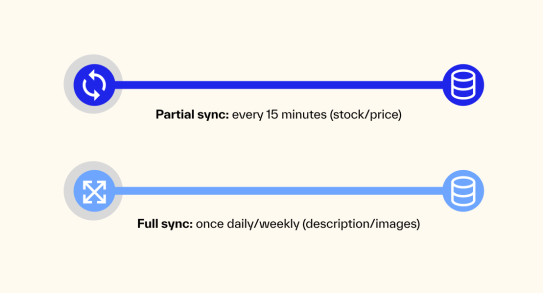
For example, when the price or availability of a product is updated in the PIM system, these changes should be visible as soon as possible on the website. Showing customers an incorrect price or an unavailable product is obviously a bad user experience—and one that leads to frustration, abandoned carts, and lost sales.
That’s why real-time updates matter. Use fast syncing for time-sensitive data like stock and pricing, and slower updates for static content like descriptions or images.
We helped one client reduce their indexing time from hours to under ten minutes. Search became more accurate, trust returned, and conversions improved.
Search That Speaks the Local Language
Expanding internationally means more than translating product descriptions. Search itself must adapt—across languages, dialects, spelling variations, and context.
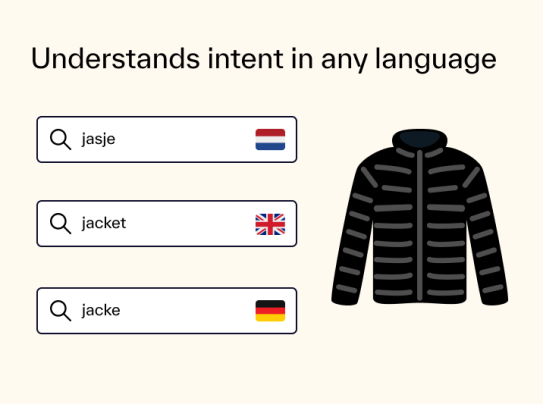
A Dutch shopper might search for “jas.” A British one for “coat.” A German user for “jacke.” They all want the same thing—but will your search understand them?
“Automate synonyms, ignore stop words, and handle plurals and spelling differences.”
One of our clients needed a single search solution for five countries. Manual rules were out of the question. We helped them implement automated linguistic parsing that handled plural forms, regional spellings, and language-specific stop words. The system didn’t just translate—it understood intent.
What You Actually Need
Scalable search means:
- Synonym mapping that adapts to real user language
- Sub-second query responses, even under load
- Indexes that update when your business does
- Search that flexes across borders, spelling systems, and languages
“Search should never slow you down. It should carry you forward.”
