


CRO benchmarks in practice: Why many companies Don’t seize their full potential
Many companies fail to maximize their revenue potential despite high marketing expenditures because they do not make sufficient use of conversion rate optimization (CRO). This article explains why CRO often underperforms, which success factors are crucial, and how a systematic, data-driven approach enables sustainable growth.
Despite investing millions in marketing, most enterprise e-commerce brands convert less than 3% of their visitors. Why? Because the real growth lever - Conversion Rate Optimization (CRO) - remains underused.
In this article, we will look at why CRO efforts often underperform, and how to build a culture, process, and toolkit that unlocks real revenue growth.
The Hidden Challenges of CRO in the Enterprise Environment
Companies have long realized that more traffic doesn’t automatically lead to more revenue. Yet, the actual conversion potential often remains untapped. The main reasons are usually complex technical structures, no holistic view of customer journeys, lengthy coordination processes, and a lack of focus on data-driven optimization.
To succeed in this environment, a clear CRO strategy and the courage to actively address internal hurdles is required. Often, it’s not technical issues but cultural barriers that slow things down: lack of ownership within the team, fragmented responsibilities, and too little focus on relevant KPIs.
Business Value: Why CRO Really Pays Off
The business benefits of CRO go far beyond classic marketing goals. With every optimized buyer journey, the value per customer increases. A better user experience directly leads to fewer checkout dropouts, stronger customer loyalty, and a significant ROI without additional costs for more traffic.
Investment in conversion optimization is not an add-on, but a growth multiplier and revenue amplifier that turns each visitor into a more valuable asset, all while increasing customer satisfaction.
The Ideal Scenario: What Successful CRO Looks Like
CRO should not be seen as a one-off project. The true value of CRO can be reaped after it becomes an established and continuous process within the company. Teams embracing the experimentation mindset work in an agile, data-driven way; constantly testing new approaches, learning, and setting measurable goals that have a direct business impact.
With modern analytics and testing tools, teams continuously uncover insights about customer behavior and translate them into tangible conversion gains. The online shop then evolves into a dynamic experience: personalized product suggestions, segmented journeys, and intuitive checkout flows that feel effortless.
Methodology: The Path to More Conversions
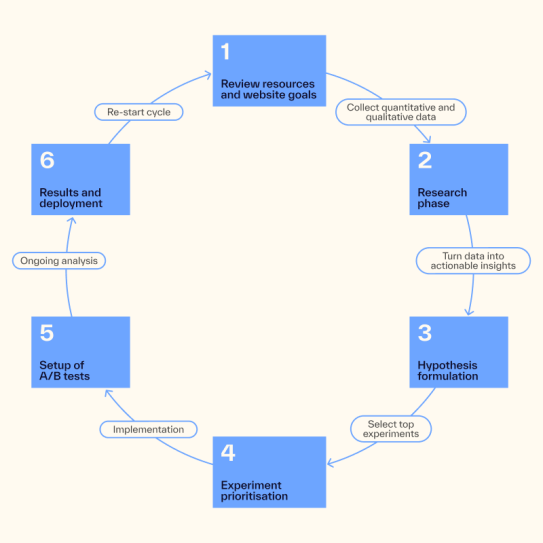
Only a systematic approach unlocks the full potential of CRO. Success starts with clearly defined KPIs, a strong data foundation, and a disciplined testing process.
Leading companies follow a structured methodology that connects insights to action - continuously prioritizing, testing, and refining along the customer journey. They make progress transparent for all stakeholders, ensuring that every experiment not only improves conversion rates but also strengthens organizational learning and alignment.
Top 5 Key CRO Levers
Among the key CRO levers we find:
- Data & Analytics: Use advanced analytics tools to identify conversion bottlenecks and track user behaviour across all key funnels.
- User Feedback: Collect qualitative insights through surveys, heatmaps, and session recordings to understand user intent and pain points.
- Personalization: Deliver dynamic content and recommendations based on behaviour, context, and purchase history to increase relevance.
- UX & Design Consistency: Ensure a visually coherent, intuitive interface that minimizes cognitive load and supports seamless decision-making.
- Trust & Credibility: Strengthen confidence with clear policies, social proof, and consistent brand messaging at every touchpoint.
BONUS - Continuous Learning Culture: Document every test, share results openly, and turn insights into repeatable best practices across the organization.
Success Factors and Pitfalls: What Companies Should Consider
CRO delivers the greatest impact when teams collaborate across departments under shared goals and accountability. The biggest pitfall is treating optimization as a one-time project rather than an ongoing discipline. Sustainable success comes from continuous experimentation, skill growth, and a culture that embraces learning from both wins and failures.
The following comparison can help to identify areas of growth looking at success factors vs common pitfalls that determine whether CRO efforts lead to lasting impact or losing momentum.
| Success Factors | Pitfalls |
|---|---|
| Clear, seamless user experience across all devices. | Complex or confusing navigation and checkout processes. |
| Fast loading times throughout the shop, especially at checkout. | Neglect for mobile optimization and long loading times. |
| Building trust through transparent information and quality seals. | Missing or inconsistent trust elements in the shop. |
| Continuous, data-driven optimization and testing. | No clear KPI orientation or sporadic use of tests. |
| Personalized communication and recommendations based on user interests. | Too many distractions, pop-ups, or irrelevant recommendations. |
Recognizing success factors or pitfalls is just the beginning as real impact comes from the right processes and consistent execution.
Conclusion
When executed strategically, CRO drives measurable business value, higher ROI, and lasting competitive agility. Organizations that embed optimization as a company-wide mindset don’t just convert more - they build smarter, more adaptive customer experiences that increase user satisfaction, ultimately boosting revenue.
